The Quote Is a Promise
Instant address-based quoting for last-mile delivery
Replacing a wait-for-a-callback quote with an instant one — my first project as a developer.
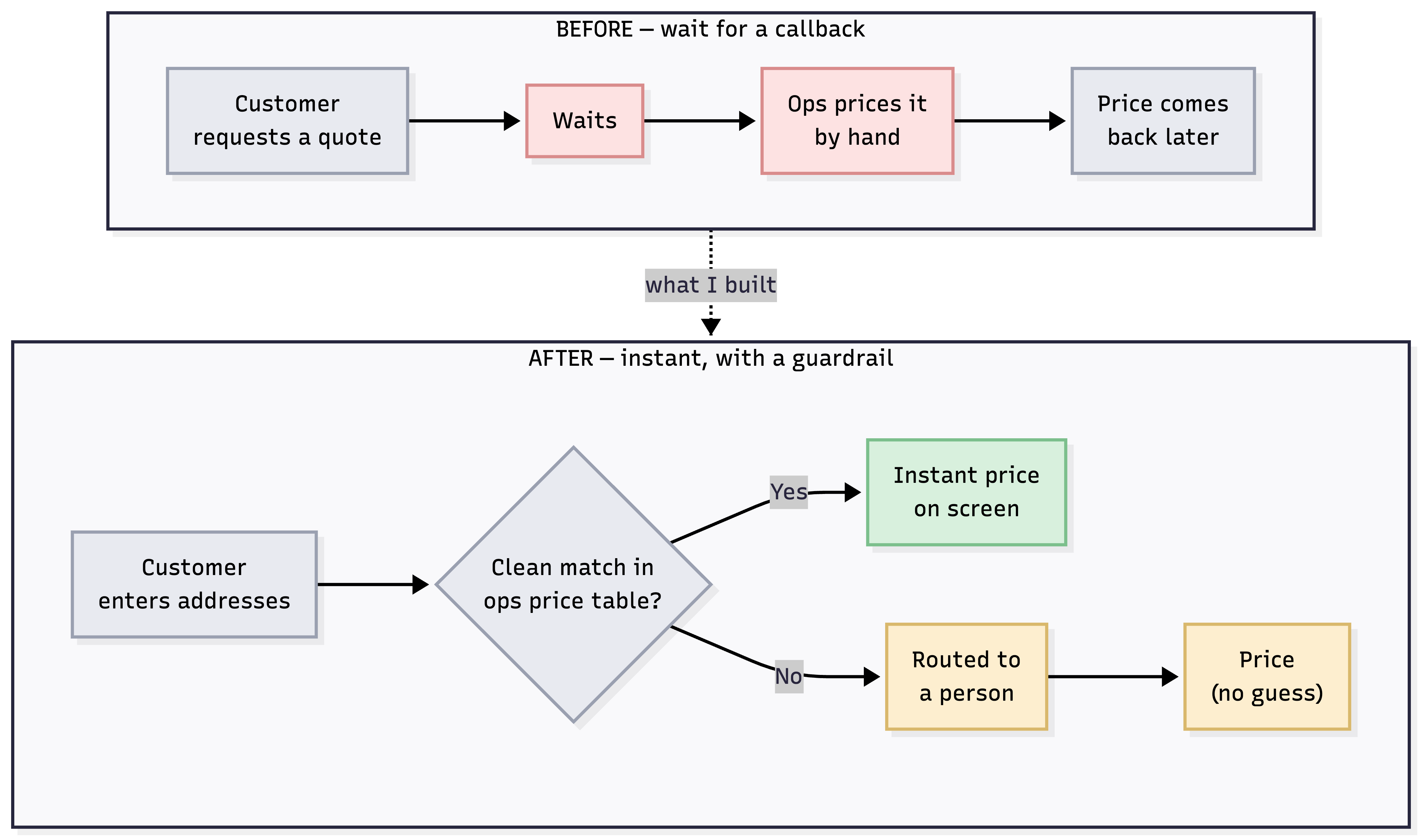
This was the first thing I built as a developer. On a last-mile delivery platform, getting a price meant asking for a quote and waiting: a customer submitted a request, someone priced it by hand, and a number came back later. That wait landed at the worst possible moment — the instant a customer is deciding whether to commit — and every delay there quietly costs you the people with the most intent.
The fix was less glamorous than the wait made it look. The ops team already maintained a price table by zone. What didn’t exist was a way for a customer to reach that number without a human in the loop. So I built the path that takes the addresses a customer enters, matches them against that table, and returns the price on the spot. The pricing itself was the ops team’s work; what I added was the instant lookup and the flow around it.
The one judgment call I’d still defend.
There was a decision in here that was mine, and it’s the part of this project I’m actually proud of. A delivery quote isn’t a suggestion — the moment the platform shows a number, it’s on the hook for it. So the real question wasn’t just “can I return a price fast.” It was “what does the system do when it can’t cleanly match the addresses to a row in the table.” The easy answer is to show a best guess. I didn’t want to, because a fast quote the platform can’t honor is worse than a slow one. So anything that didn’t match cleanly routed to a person instead of guessing. The instant path took the clean cases; a human still caught the rest.
I want to be precise about the size of that: it’s not a confidence-scoring engine or a pricing model. It’s a guardrail — match cleanly or hand it to a human — and choosing it over “just return something” was the judgment, not the machinery.
What shipped.
For clean matches, quoting went from “submit and wait” to a price on screen at the moment of intent, and the manual pricing step stopped being something every customer queued behind. The cases the table couldn’t cleanly answer still went to a person — by design, not by accident.
I didn’t instrument this, so I can’t give a clean rate — but in practice the large majority of orders cleared the instant path without ever touching a person. The fallback stayed the exception, which is exactly the condition the design depends on.
What I’d watch.
The fallback is only a win while the share of quotes needing a human stays low. If it creeps up, the bottleneck I removed doesn’t vanish — it just relocates to a smaller queue. So the number I’d keep an eye on isn’t speed, it’s what percentage of quotes still need a person. That’s the early warning that the instant path is covering less than it looks like it is.
Looking back.
It was my first project, and in hindsight the useful lesson wasn’t the lookup — it was noticing that “automate the quote” and “automate the price” are different problems. I automated the delivery of a price the ops team already stood behind. Computing a trustworthy price from scratch would have been a much harder problem, and the design is better for not pretending otherwise: the clean cases got faster, the hard cases stayed human, and nobody got a number the platform couldn’t keep.